Tuesday, December 10, 2013

Veteran celebrates new homecoming

U.S. Army Cpl. Christopher Sullivan celebrated a second homecoming on December 4 with his family courtesy of Operation Finally Home.

Cpl. Sullivan and his family were presented the keys to their new home in League City at a welcoming home event hosted by Operation Finally Home in partnership with Harbour Classic Builders, Texas Home Improvement with Jim Dutton, Reliant Energy, the Houston Texans Matt Patrick, NewsRadio 740 and members of the League City community.

"We just want to thank Chris for your service, and we hope you like your new home," said Murphy Yates, president of Harbour Classic Builders on Wednesday.

In 2011, Sullivan returned home to California, recovering from injuries suffered during a suicide bombing in Afghanistan. During his homecoming party, he was shot trying to break up a fight between a family member and a guest and was paralyzed from the neck down.

Operation FINALLY HOME is a non-profit organization that honors wounded and disabled vets and widows of fallen soldiers with mortgage-free, new custom-built homes.

"Chris has sacrificed so much during his years of service," said Rusty Carroll, vice president of Operation Finally Home. "Operation Finally Home continues to be thankful for sponsors like Harbour Classic Builders, the Houston Texans and THI because they allow us to fulfill our mission in thanking these veterans and the widows of the fallen in the best way we know how, by providing them with mortgage-free homes."

The mission of Operation Finally Home, established in 2005, is to provide wounded and disabled vets and their families' mortgage-free homes to contribute in their efforts to rebuild their lives.

"Seeing Chris' expression as he arrived at his new home was a moment none of us will soon forget," said Yates. "The League City community has truly embraced this build, and we are honored to have been a part of this project."

Sullivan first learned about plans for his new home at a Houston Texans game in December 2012 as a surprise.

"The Houston Texans are so grateful to our service members, veterans and their families for their sacrifices," said Jamey Rootes, president of the Houston Texans. "We are honored to partner with Operation FINALLY HOME to support our wounded community. Providing Chris with a new home is a way for all of us to say thank you for what he has done to protect our nation and our freedom, and it will help him and his family get a fresh start."

To learn more, visit OperationFinallyHome.org[1].

Source : http://www.yourhoustonnews.com/bay_area/news/veteran-celebrates-new-homecoming/article_57181958-12be-5283-b309-1a4e9e185c79.html

FHA Drops the Ceiling on Home Mortgages

The U.S. Federal Housing Administration will scale back the size of loans it backs to a maximum $625,500 at the beginning of 2014 to reduce its share of the U.S. mortgage market, the agency said on Friday. Currently, the FHA's limits that vary by region, from $271,050 up to $729,750 in the country's most expensive housing markets. The FHA's move brings it partly in line with taxpayer-owned mortgage financiers Fannie Mae and Freddie Mac, which use a $417,000 cap in most areas and have an upper limit of $625,500.

"As the housing market[4] continues its recovery, it is important for FHA to evaluate the role we need to play," Carol Galante, FHA Commissioner, said in a statement. "Implementing lower loan limits is an important and appropriate step as private capital[5] returns to portions of the market." Those in favor of lower limits say the government should not be helping borrowers at the high end of the real-estate market. The FHA became a major backer of new mortgage financing during the housing crisis when banks[6] became reluctant to lend.

The reductions will impact buyers in about 650 counties across the country with relatively high home prices. Loan limits are based on median home prices in each county, and they do not go any lower than $271,050. That floor will remain unchanged, the FHA said.

The FHA, which is mainly funded through insurance pr emiums it brings in, backed about a third of loans used to purchase homes last year. In September, the FHA said it needed to draw $1.7 billion in cash from the U.S. Treasury to help cover losses from troubled loans, marking the first time in its 79-year history that it has needed aid. With an FHA loan, buyers can put down as little as 3.5 percent. The FHA, which does not make loans, provides mortgage insurance to borrowers without enough of a down payment to qualify for prime loans.

Source : http://realestate.aol.com/blog/2013/12/09/fha-limits-size-home-mortgages/

Thursday, December 5, 2013

Jobs growth drives mortgage rates

NEW YORK (CNNMoney)

Mortgage rates jumped this week on stronger-than-expected economic reports, according to Freddie Mac's weekly survey.

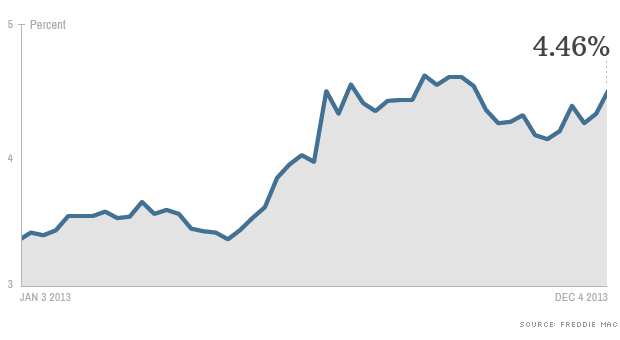
mortgage rates 12413The 30-year, fixed-rate loan, the most popular product for homebuyers, rose to 4.46% from 4.29% last week. The average rate on a 15-year, fixed-rate mortgage, typically used for refinancing higher interest mortgages, also jumped 0.17 percentage point to 3.47%.
This week's rate approached a high for the year. Rates on the 30-year have ranged from a low of 3.34% in the first week of January to a high
Source : http://rss.cnn.com/~r/rss/money_realestate/~3/enqLEtDl-_c/index.html

Wednesday, December 4, 2013

Soaring new home sales: Not what they seem

It was the sharpest jump in more than three decades, but housing watchers are already poking holes in the new home sales numbers. After delays due to the government shutdown, data for both September and October were released together, in addition to a large downward revision for August. Follow the numbers, and the gains are not quite what the headline seems.

Contracts signed to buy newly built homes jumped 25.4 percent in October month to month, after falling 6.6 percent in September from August. The seasonally adjusted annual rate went from an originally reported 421,000 units in August, which was revised down to 379,000 units, and to 354,000 units in September. The number for September was a 10 percent drop from September of 2012. It then rose to 444,000 units in October. There is a nearly 20 percent margin of error on all these numbers.

"The October 'preliminary' report released this morning, along with the terrible August and September data, is the outlier and will be revised lower next month in line with the new trend lower that began in July," noted housing analyst Mark Hanson.

August sales estimates were revised down by 15 percent on an unadjusted basis and September sales dropped from there.

"Both the September and October new home sales data were released together and averaged 399,000 annualized versus the estimate of 424,000 and compares with the average year-to-date of 422,000," said Peter Boockvar, chief market analyst of economic advisory firm  The Lindsey Group. "The weakness seen in July through September was clearly in response to the rise in rates and the almost 25-basis-point decrease in mortgage rates in October seemed to have brought out buyers that were previously on the fence."
[3]

Builders say it wasn't just the falling rates, but the end of the government shutdown.

Source : http://www.cnbc.com/id/101246658

New Home Sales Surge in October as Supply Dwindles


New Home Sales

Lucia Mutikani
WASHINGTON -- Sales of new U.S. single-family homes recorded their biggest increase in nearly 33½ years in October, suggesting the housing market recovery remains intact despite higher mortgage rates.
The Commerce Department said Wednesday[1] sales jumped 25.4 percent to a seasonally adjusted annual rate of 444,000 units. It also said new home sales fell 6.6 percent in September.
The release of both the September and October reports was delayed because of a 16-day partial shutdown of the government[2] last month.
Economists polled by Reuters had expected new home sales to set a 428,000-unit pace last month.
Compared with October last year, new home sales were up 21.6 percent.
The strong rise in new home sales, which are measured when contracts are signed, suggested higher mortgage rate had not derailed the housing market recovery.
Higher mortgage rates[3] have slowed the pace of home sales, but demand for accommodation as household formation continues to recover from multidecade lows is keeping demand supported.
Home resales fell in October for a second straight month and confidence among single-family home builders has ebbed somewhat since nearing an eight-year high in August.
Strong new home sales in October saw the stock of houses on the market falling 3.7 percent after touching their highest level in nearly three years in September. Despite the tight supply of properties, the median price of a new home slipped 0.6 percent from a year-ago.
At October's sales pace it would take 4.9 months to clear the houses on the market, down from 6.4 months in September. A supply of 6.0 months is normally considered as a healthy balance between supply and demand.
Source : http://realestate.aol.com/blog/2013/12/04/new-home-sales-surge-october-higher-mortgage-rates/


New mortgage rules may mean less choice

(CNNMoney)

New rules launching early next year designed to make mortgages safer may result in less choice for borrowers.

The problem: small banks may drop out of the business because of the cost of tougher regulations.

Beginning Jan. 10, banks have to ensure that monthly mortgage payments are affordable, a result of the Dodd Frank law passed in 2010. The failure to do so carries strict penalties.

"My concern is that we're going to be in an environment where some lenders are too small to comply," said David Stevens, CEO of the Mortgage Bankers Association.

During the housing bubble, some banks issued loans without even checking applicants' income or assets.

Under the new rules, lenders must carefully determine that borrowers have the ability to repay their loans. That means, for example, that the banks can't lend to anyone whose total debt payments would exceed 43% of their income. Lenders must carefully examine and double check pay statements, bank records, tax returns and other paperwork provided by borrowers.

Banks will have to make three main changes, according to Anthony Hsieh, CEO of loanDepot, an online mortgage bank.

They will have to update their underwriting policies and procedures, change their technology and retrain staff.

Is there a housing bubble in California?

Already, lending had become more complicated.

Five years ago, Total Mortgage, a mid-sized lender in Connecticut, had a single attorney on retainer to handle compliance issues, according to its president John Walsh.

Today, Total Mortgage has three full-time workers who work exclusively on compliance in addition to the outside counsel, even though his business has not grown.

"I expended a lot of effort to stay ahead of the new regulations," Walsh said. "You just can't make mistakes these days."

Related: 10 Best Places to Retire[4]

Banks large and small are hiring outside companies to handle a share of their mortgage underwriting to ensure the quality, according to Jeff Taylor, co-founder of Digital Risk, a provider of risk, compliance and transaction management services.

Big banks can handle the cost, but small lenders may not be able to afford all the extra manpower.

The changes are coming at an already challenging time. Fewer homeowners have been refinancing their old, high interest mortgages. "Now that the refi boom is over, we'll see a lot of small banks fading away," said Taylor.

It's possible that bankers, never receptive to regulation, may be overstating the impact of the new rules, according to Ellen Schloemer, spokeswoman for the Center for Responsible Lending, a consumer advocacy group.

She points to an October report from CoreLogic that asserted that lenders should be able to meet the requirements. The report was written by Margarita Brose, a consultant on lender risks, and Faith Schwartz, who ran Hope Now, a coalition of lenders, consumer groups and government organizations that fights foreclosure.

Lenders will "figure out a way to deliver . . . mortgages in a way that meets all the regulatory requirements, incorporates sound lending and consumer protections -- and makes a profit," according to the report's authors.

Source : http://rss.cnn.com/~r/rss/money_realestate/~3/Zg2Uv1bAM6U/index.html

Mortgage Applications Slide for Fifth Straight Week

Luciana Lopez

NEW YORK -- Applications for U.S. home loans tumbled in the latest week, led by a sharp slide in refinancing applications, data from an industry group showed Wednesday.

The Mortgage Bankers Association said[1] its seasonally adjusted index of mortgage application activity, which includes both refinancing and home purchase demand, sank 12.8 percent in the week ended Nov. 29.

The week's results included an adjustment for the Thanksgiving holiday last Thursday, the group said.

The data marked the fifth straight weekly drop for the index, taking it to its lowest level since early September.

The fall in mortgage applications comes as investors try to gauge when the U.S. Federal Reserve[2] might exit its bond-buying program.

The Fed has said it would begin to scale back its $85 billion a month in purchases of Treasuries and mortgage-backed securities when policy makers are convinced of a steady, self-sustaining recovery.

But data on the world's biggest economy[3] have been mixed, leaving investors uncertain about the future path of U.S. monetary policy.

MBA data showed 30-year mortgage rates rose 3 basis points in the latest week to 4.51 percent.

The refinancing index sank 17.5 percent while the purchase index, a leading indicator of home sales, fell 4.1 percent.

The mortgage survey covers over 75 percent of U.S. retail residential mortgage applications, according to MBA.

Source : http://realestate.aol.com/blog/2013/12/04/mortgage-applications-slide-fifth-straight-week-mba/